AI in Industry and Logistics: From Pilot to Real Value
AI is prioritised highest among IT investments in industry and logistics – yet only 2.4% have reached a transformative AI maturity level. The gap between ambition and reality is large. In this article, based on our latest report, we review where the industry stands, what is hindering progress, and how you can take AI in industry and logistics from pilot projects to real business value.

Big ambitions but low maturity
When we look at how the industrial and logistics sector is investing in IT right now, we see that AI and machine learning are given the highest priority. An image that could place the sector at the forefront when it comes to AI and innovation. But the reality looks a little different.
A full 81% of industrial and logistics companies are at an immature or basic AI maturity level. This means sporadic use or initiated projects without a clear connection to business strategy. Only 2.4% have reached a transformative level where AI drives strategic decisions.
However, the fact that 65% are at a basic level is seen as a positive signal. The majority have started the journey. The challenge lies in moving on from experiments to scalable production.
Why AI initiatives in industry and logistics get stuck
But what is preventing companies from progressing with their AI initiatives? Here, data quality and lack of expertise are highlighted as concrete obstacles. Security and privacy issues are also a problem, as well as governance, risk and compliance. This reflects uncertainty about how AI is allowed and should be used, not least in light of the EU AI regulation.
There is also resistance to change which causes AI initiatives to remain within the IT department without anchoring in the business. Infrastructure and vendor lock-in are hardly seen as a problem, however. This points to the fact that the sector does not see the technology as the barrier, but the organisation, the data and the competence.
The majority have started the journey. The challenge lies in moving from experimentation to scalable production.
Guide: Get started with AI safely and legally
Data quality: The biggest obstacle for AI in industry
If your data is not reliable, neither will the AI be. With data quality as the biggest perceived obstacle in implementation, this is step one. Start by inventorying the data you already have. Where is it, what is the quality like, and what shortcomings need to be addressed? Often it is not about collecting more data, but making existing data usable.
Data sharing in logistics chains: Ownership and agreements
If the AI is trained on data from several parties, who owns the model then? What happens to customer data when the relationship ends? In the logistics multi-partner reality, these questions are not theoretical. Regulate contractually before you start, not afterwards. Define early who owns what, how data may be used, and what happens to models and insights if the collaboration ends.
Risk classification according to the AI Regulation
The EU AI Regulation classifies AI applications according to risk level. Industrial applications affecting safety, such as AI-driven quality control or predictive maintenance in critical infrastructure, can end up in the high-risk category with requirements for documentation, human oversight, and risk management. Map where your applications fall early. It is easier to build compliance from the start than to adapt later.
Choose the right operating model for your situation
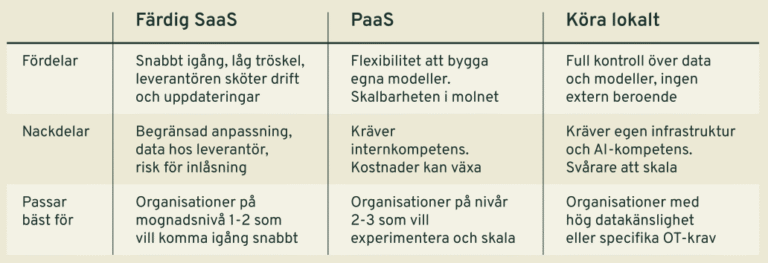
There is no universal correct choice, but there is a good choice for you right now. Start from your maturity level, your data requirements, and internal capacity. The choice does not have to be forever either. Many start with SaaS to test the value and then move to another model as competence and needs are refined.
The prerequisite: Anchor AI beyond IT
AI that provides real value requires anchoring beyond the IT department. With only 2.4% at the transformative maturity level and resistance to change as one of the larger obstacles to successful AI initiatives, this is a prerequisite. Let the business own the problem, let IT and data enable the solution.
5 common questions and answers about AI in industry and logistics
- How mature is the industrial and logistics sector in AI?
81% of industrial and logistics companies are at an immature or basic AI maturity level. The majority have started the journey, but only 2.4% have reached a transformative level where AI drives strategic decisions. - What are the biggest obstacles to AI in industry and logistics?
The most common obstacles are poor data quality, lack of expertise, and uncertainty about security, privacy, and regulatory compliance. Resistance to change and lack of anchoring within the business also cause AI initiatives to often remain in the pilot stage. - How does the EU AI regulation affect industrial companies?
The EU AI regulation classifies AI applications by risk level. Industrial applications such as AI-driven quality control or predictive maintenance in critical infrastructure can be classified as high risk, with requirements for documentation, human oversight, and risk management. - Which operational model is best suited for AI in industry: SaaS, PaaS or local operation?
It depends on the organisation's maturity level, data requirements, and internal capacity. SaaS is suitable for a quick start at low maturity, PaaS offers flexibility to build your own models, and local operation suits organisations with high data sensitivity or specific OT requirements. - How do you take AI in industry and logistics from pilot to scalable production?
Start by ensuring data quality, regulate data ownership contractually, map risk classification according to the AI regulation, choose an operational model that matches your current situation, and anchor the AI initiative in the business, not just the IT department.